The Chinese market is locking out undesirable foreign cars

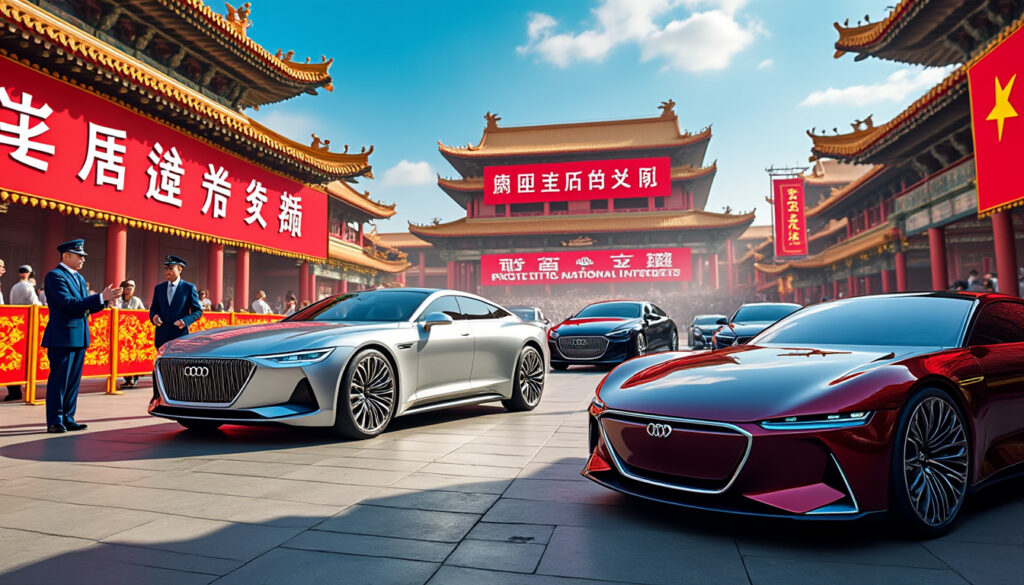

In 2025, the global automotive market is undergoing a true transformation. Recent figures illustrate a major upheaval: China, once a welcoming land for foreign cars, is reinforcing its barriers and significantly reducing its imports. This change occurs in a context where the Middle Kingdom, already recognized as the global leader in electric vehicles, sees its domestic brands, such as BYD, NIO and Xpeng, increasingly dominate the sector.
A plummet in imports 🚗📉
The statistics leave no doubt about the extent of the market contraction. In March 2025, vehicle imports to China fell by 27% compared to the previous year. In the first quarter, the decline even reaches 39%, totaling only 95,000 vehicles according to the China Passenger Car Association (CPCA).
An uninterrupted decline in imports
Since 2017, the volume of imports has been in continuous decline. The figures are striking:
- 2017: 1.24 million vehicles
- 2024: 700,000 vehicles
- Average annual decline: 8%
This trend is not expected to reverse anytime soon, as China continues to promote its own manufacturers at the expense of foreign brands like Volkswagen, Toyota, Ford, or BMW.
The lag of imported electric vehicles ⚡️
If the general decline is concerning, the situation for electric vehicles is catastrophic. In the first quarter of 2025, imports of battery electric cars plummeted by 82% compared to the previous year, with only 1,345 units imported. This staggering figure is not without consequence as Chinese players gain the upper hand.
| Type of vehicle | Import drop | Number imported |
|---|---|---|
| Battery Electric Vehicles (BEV) | -82% | 1,345 |
| Plug-in Hybrid Vehicles | -77% | 1,078 |
These alarming figures testify to the rise of Chinese brands, which are creating attractive models, both technologically and in price. This phenomenon represents a major paradigm shift in the sector.
Trade tensions: a delicate ground 🌍⚖️
Alongside this transformation, global economic tensions, notably between the United States and China, are profoundly influencing the automotive sector. The tariff war has become a real battlefield, where high tariffs have redefined trade flows. This dynamic impacts all players, including brands like Mercedes-Benz, Hyundai, and Nissan.
- U.S. protectionist measures on Chinese electric vehicles
- Reactions with countermeasures in China
- Impact on foreign investments
Exceptions to a general trend 🚀
Not everything is bleak; some nations, like Slovakia, are benefiting with an increase in exports to China, notably:
| Country | Increase in exports |
|---|---|
| Slovakia | +1,931 vehicles |
| Belgium | +98 vehicles |
| Poland | +85 vehicles |
| Vietnam | +40 vehicles |
| Spain | +23 vehicles |
However, these successes are marginal compared to the global collapse. The future of foreign brands appears increasingly uncertain, and historical manufacturers may see their market share erode.
A future to redefine for the automotive industry 🌟
The automotive world is in full flux. China, once a land of import, is becoming a bastion of export, fueling the European and international market with its electric vehicles. In the face of this phenomenon, automotive giants must redefine their strategies. Traditional brands like Peugeot and Renault must adapt to this new context, while their domestic competitors seize control of the market.
The coming months are crucial. The power shift to the East is tangible, leading to profound implications for the industry. Chinese consumers are shifting their choices towards local brands, thereby redefining the offer and competitive dynamics. The question remains: how will the historical players of an ancestral industry react to this unprecedented shift?


Si vous souhaitez lire d'autres articles tels que The Chinese market is locking out undesirable foreign cars, consultez la catégorie Non classé.
-
Marvin Florestan says:
La decline des importations en Chine change tout pour les marques étrangères.
-
La montée des marques chinoises change vraiment le paysage automobile mondial. C'est fascinant!
-
C'est incroyable de voir comment le marché automobile change si rapidement en Chine.
Leave a Reply
Articles relatifs