Tesla: the utility of the Cybertruck finally revealed!

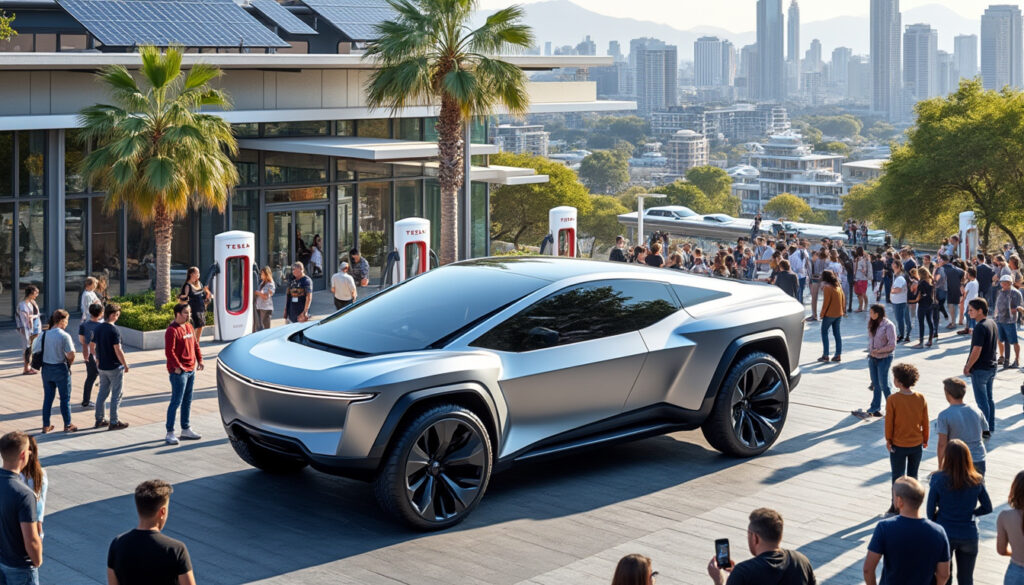

The launch of the Tesla Cybertruck was supposed to disrupt the electric utility vehicle sector with its futuristic design and innovative technical promises. Yet, despite enormous initial enthusiasm, sales remain sluggish, and Tesla appears to struggle to impose this unique pickup on a market dominated by entrenched habits. Curiously, an unexpected new facet of this vehicle seems to be emerging, providing astonishing insights into its true utility. What secrets does this rugged-looking truck and its disruptive approach conceal? Amidst commercial stakes, bold communication strategies, and technical challenges, could the Cybertruck hold more than one card up its sleeve to redefine sustainable mobility? Let us discover together why the Cybertruck might be much more than just an electric pickup.
An electric beast with bold style: the Tesla Cybertruck unveils its identity
Since its first images, the Cybertruck asserts itself as a visual manifesto. Its ultra-resistant stainless steel body, angular and minimalist, shocks as much as it fascinates. This aesthetic break marks Tesla's true desire to break free from traditional automotive codes. Far from refined curves, the Cybertruck embodies a utilitarian and futuristic design, built to last. But beyond its unusual silhouette, what are its true technological and functional qualities?
The Cybertruck incorporates several major innovations, reflecting Tesla's ongoing quest for sustainable mobility. For instance, its electric range can exceed 500 kilometers, thanks to a next-generation battery, a notably competitive figure in the heavy electric vehicle category. This performance is accompanied by a remarkable towing capacity, exceeding 6 tons, which is not just a commercial argument but a genuine practical advantage for demanding users.
Several points shape the identity of the Cybertruck:
- A stainless steel armor, enhancing safety and durability against external aggressions.
- A spacious and modular cabin, designed to adapt to various uses, be they professional or personal.
- The integration of autonomous driving, true to Tesla's ambition to revolutionize automotive technology.
- A high-performing electric motor, ensuring driving that is as powerful as it is silent, ideal for challenging terrains.
- An automatic suspension system, capable of adjusting according to loads and terrain to optimize comfort and maneuverability.
Each of these characteristics emphasizes that Tesla is not simply designing an electric car but rethinking the automobile altogether. This sharp approach, though disconcerting at first glance, responds to a precise vision of green and autonomous mobility. However, a thorough examination reveals that the launch of the Cybertruck is facing unexpected difficulties that hinder its widespread acceptance.

| Key Features | Details |
|---|---|
| Maximum Range | 507 km (tri-motor model) |
| Towing Capacity | 6,350 kg |
| Body Materials | Ultra-resistant stainless steel |
| Technology | Autonomous driving, adaptive suspension |
| Base Price | $62,490 (about €55,000) |
Sales on the rise and fall: understanding the Cybertruck's challenges in the American market
Despite unprecedented media buzz during its presentation, the Cybertruck struggles to captivate the American public, which is very attached to traditional pickup codes. Sales figures illustrate this difficulty: production has peaked at around 46,000 units sold compared to the initial targets that projected 250,000 vehicles annually, or even 500,000 envisioned in the long term.
Several factors explain this fragile dynamic. First, the launch period was marked by notable technical problems. A defect in the body panels necessitated massive recalls, damaging customer trust in the product's reliability. Such complications, hindered by the complexity of such an innovative design, raise a paradox in which extreme innovation increases operational risks.
Furthermore, the image of the Cybertruck, although iconic, remains divisive. Many traditional pickup buyers expect a vehicle with a more conventional look, fitting into a familiar narrative and world of ruggedness. The geometric and almost brutal style of the Cybertruck does not appeal to all tastes, creating a psychological barrier between the offering and a large segment of consumers.
Add to this a delicate economic and social context for Tesla: the company has recorded a historic decline in sales following a series of boycott calls and various controversies. This tense climate weighs heavily at a time when the manufacturer hoped to capitalize on the rising tide of electric vehicles in retail.
Paradoxically, it is in this adversity that Tesla reveals the unexpected versatility of the Cybertruck, adopting an unexpected role within its fleet.
- Initial technical problems: recalls related to body panels.
- Bold and divisive design: a psychological constraint to mass adoption.
- Tense commercial context: decline in sales, calls for boycotts.
- Aspiring production goals versus reality of sales.
- Impact on Tesla's overall perception in the North American market.
| Goals vs Reality | Tesla Forecast | Actual Sales |
|---|---|---|
| Planned annual production | 250,000 units | 46,000 units |
| Base price (USD) | 62,490 | Stable |
| Technical recalls | 0 | Multiple causes |
| Effect on consumer perception | Optimistic | Mixed |
An unexpected publicity stunt: the Cybertruck serving the restyled Model Y
In the face of these disappointing sales, Tesla has shown remarkable creativity in managing its brand image. A recent example illustrates this strategy brilliantly: a Cybertruck was spotted in the streets of Temple, Texas, towing a freshly restyled Model Y, enclosed in a glass capsule. This unusual staging serves as a rolling billboard and aims to draw attention to the renewed electric SUV, hoping to inspire a resurgence of interest.
This initiative not only illustrates a capacity for marketing adaptation but also reveals a practical trick of the Cybertruck, often underestimated. Indeed, the power and robustness of the electric pickup make it an excellent towing vehicle, ready to perform heavy and symbolic tasks that surpass mere transport.
This dual-use opens a new perspective on the real utility of the Cybertruck:
- Mobile advertising support: an asset to highlight model launches.
- Exceptional towing force: a true mechanical powerhouse for sustainable mobility.
- Affirmation of local roots: Made in Texas, a strong economic and political argument.
- Functional versatility: beyond a mere vehicle, a medium for communication and performance.
- Dynamic demonstration: the staging amplifies the visual and emotional impact on the public.
| Cybertruck Functions in the Campaign | Description |
|---|---|
| Towing the Model Y | Transporting a vehicle in a glass capsule |
| Mobile ambassador | Visibility in the streets of Temple (Texas) |
| Promotion of Made in USA | Showcasing local manufacturing |
| Reinforcing image | Versatility and robustness highlighted |
| Innovative marketing | Original and impactful use |
The Cybertruck, an overlooked pioneer of sustainable electric mobility
Beyond its sharp aesthetics and fluctuating sales figures, the Cybertruck embodies a true rolling laboratory for sustainable mobility. Its 100% electric propulsion is part of the grand energy transition towards renewable energies, essential to limit the ecological impact of the automotive sector. Its powerful motor and onboard technologies promote a smarter, more autonomous, and cleaner driving experience.
The brand relies on several levers to demonstrate that the Cybertruck is not limited to its futuristic appearance:
- Reduction of CO2 emissions: replacing thermal engine pickups that are particularly polluting.
- Optimizing consumption through energy recovery during braking and intelligent battery management.
- Autonomous driving technology helping to reduce accidents and traffic.
- Recycled and recyclable materials used in construction to preserve natural resources.
- Encouraging sustainable mobility supporting professional and personal travel without compromising performance.
This approach is part of a larger movement, where technological innovation combines performance, ecology, and comfort. Even though the Cybertruck has faced criticism, it remains a key player in changing mindsets in electric vehicles and an undeniable source of inspiration.
| Environmental Impacts | Benefits of the Cybertruck |
|---|---|
| Energy consumption | Optimized thanks to Tesla technology |
| CO2 reduction | Zero emissions during use |
| Material recycling | Recyclable stainless steel |
| Accident reduction | Advanced autonomous driving |
| Encouragement of green mobility | Efficient and powerful sustainable transport |
Future Perspectives: the Cybertruck facing technological and economic challenges
By 2025, Tesla must continue to face the challenge of integrating the Cybertruck into a highly competitive market where innovations continue to proliferate. The need to stabilize production, improve reliability while responding to the needs of a diverse clientele remains a major issue. The manufacturer is also working on optimizing onboard technologies, including autonomous driving and energy management to further enhance the customer experience.
Several strategic avenues could redefine the role of the Cybertruck in the medium term:
- Continuous performance improvement: increase range, reduce weight, and maximize robustness.
- Customization: offer configurations tailored to the specific needs of businesses and individuals.
- International expansion: conquer new markets by adapting the product to local standards.
- Synergies with other Tesla models: particularly marketing support, as seen with the Model Y.
- Strengthening the ecological image: integrating even greener and more responsible innovations.
The key to the success of the Cybertruck may very well lie in its ability to combine innovative design, physical robustness, advanced technology, and marketing intelligence. The puzzle lies in the subtle balance between boldness and pragmatism, which will allow Tesla to elevate its electric pickup to the rank of an indispensable reference in sustainable and high-performing mobility.
| Future Strategies | Possible Actions |
|---|---|
| Technical improvement | Battery optimization, weight reduction |
| Customization | Diverse configurations, specific options |
| Market development | Adaptation to international regulations |
| Innovative marketing | Versatile uses and targeted campaigns |
| Enhanced sustainability | Even greener technologies |
Si vous souhaitez lire d'autres articles tels que Tesla: the utility of the Cybertruck finally revealed!, consultez la catégorie Non classé.
-
Lysandre Vigneault says:
Le Cybertruck a un look incroyable, mais il faut vraiment améliorer les ventes !
-
Le Cybertruck a un design audacieux, mais il faut vraiment améliorer la fiabilité pour convaincre les acheteurs.
Leave a Reply to Lysandre Vigneault Cancel reply
Articles relatifs