Renault emblem: a creative laboratory for the future models of the Diamond



In an automotive context where innovation and sustainability dictate the future, Renault is betting on a bold approach with its concept car Emblème. More than just a show car, this model embodies a creative laboratory where design, technology, and environmental commitment come together. The result of intense collaboration between engineers, designers, and partners, the Renault Emblème unveils a futuristic and pragmatic vision intended to influence future models of the Diamond. Through its innovative elements, this demo car offers a synthesis of the major trends that will shape the mobility of tomorrow, integrating hydrogen, electricity, but also a revamped aesthetic and an interior focused on immersive experience.
Renault Emblème: a concentrate of technological innovation in service of sustainability
The Renault Emblème stands out as a true rolling laboratory combining the best technologies of the moment, responding to the growing needs for sustainability in the automotive industry. This electric shooting break, measuring 4.80 meters long, combines both a 40 kWh NMC lithium-ion battery and a hydrogen tank with a capacity of 2.8 kg, powering a 30 kW fuel cell. This dual hybrid energy source illustrates an innovative approach aimed at providing extended range while minimizing carbon footprint.
The front of the vehicle incorporates a movable grille, a symbol of advanced aerodynamic optimization. When the grille is closed, the air penetration coefficient decreases, thereby improving energy efficiency. Conversely, it opens to enhance cooling of the electrical system if necessary. This evolved device evokes technologies borrowed from Formula 1, notably thanks to the contribution of the Alpine F1 team, which also provided its expertise for the retractable active diffuser located at the rear of the vehicle.
- Energy duo: lithium-ion battery and hydrogen fuel cell.
- Improved aerodynamics: active grille and diffuser.
- Innovative accessibility: small hood providing access to the hydrogen tank and the 74-liter "frunk".
- Embedded technology: 3D-printed wipers and cameras replacing traditional mirrors.
- Photovoltaic glass roof: natural brightness and partial recharge of electrical systems.
The use of cameras, placed on the fenders and rear window, is also an example of ongoing innovation. This technology not only improves visibility but contributes to lightening the vehicle while reducing aerodynamic drag. The photovoltaic cell glass roof, in turn, revolutionizes interior energy management, allowing certain equipment to be powered by an onboard renewable energy source. This marriage between energy efficiency and technological advancements thus crystallizes Renault's desire to innovate at the crossroads of performance and environmental respect.
| Feature | Technical detail | Impact on sustainability |
|---|---|---|
| Electric motor | 160 kW | Reduction of direct emissions |
| Battery | 40 kWh NMC | Range in electric mode |
| Hydrogen tank | 2.8 kg | Extension of range without polluting emissions |
| Fuel cell | 30 kW | Efficient conversion of hydrogen into electric energy |
| Movable grille | Aerodynamic optimization | Improvement of energy consumption |
| Active diffuser | Retractable | Better road handling and reduced drag |
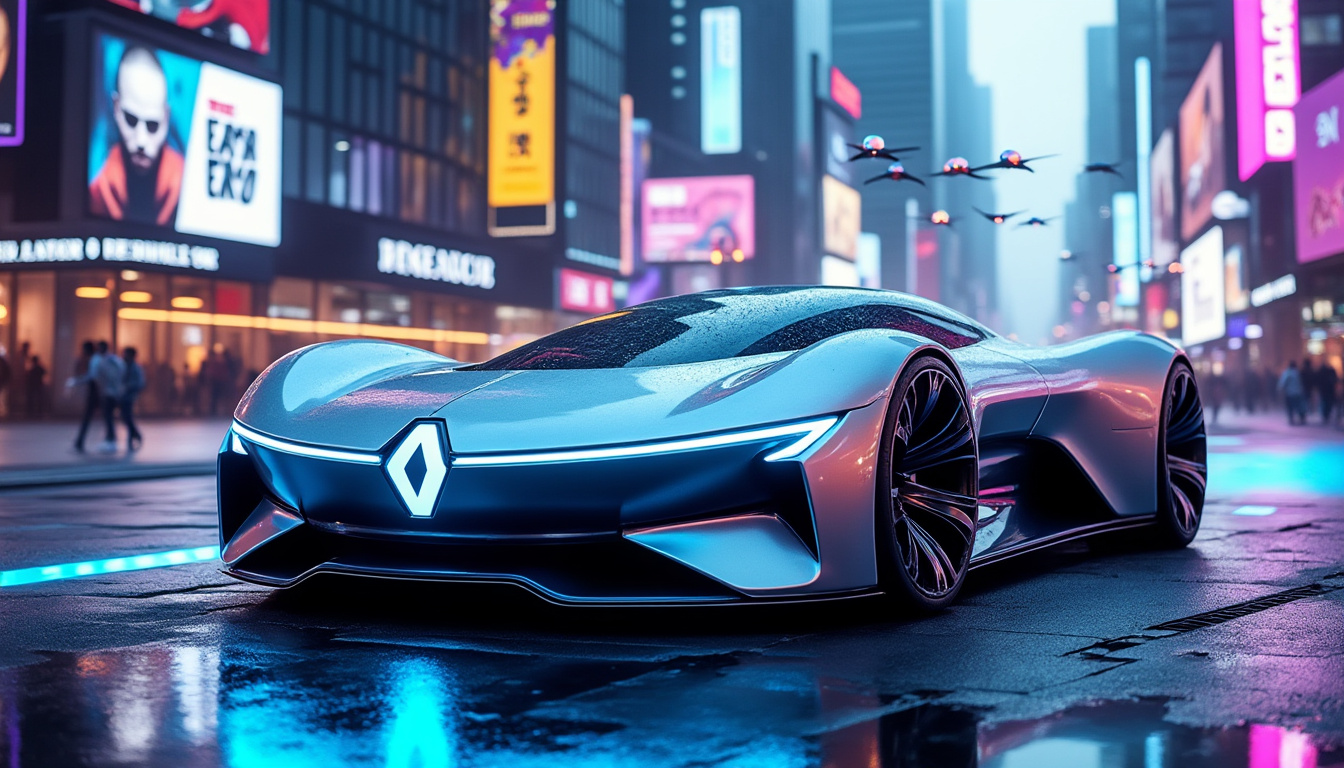
A creative exterior design that outlines the lines of tomorrow's Renault models
The Renault Emblème impresses first with its bold design, which is not just a style exercise but a preview of the future vehicles signed with the Diamond. At 4.80 meters long and with a wheelbase of 2.90 meters, this elegant shooting break silhouette fully embraces an innovative aesthetic that breaks away from current trends. Inspired by futuristic and cinematic visions like that of Blade Runner, the concept adopts a simultaneously imposing and aerodynamic look.
The movable grille, central to the reinvention of automotive design, plays a dual aesthetic and functional role. Moreover, the headlights and lights shaped in the body remain understated yet sophisticated, using the most advanced LED technology, while the side cameras replace traditional mirrors to refine the line and optimize airflow around the vehicle.
The choice of materials continues this creative stance: the body uses a combination of lightweight and durable materials, promoting long-term robustness while limiting weight, a key factor for performance and consumption. The integration of advanced technologies does not sacrifice elegance and harmony of volumes. The glass roof reflects a concern for detail both in style and energy functionality, offering natural light while participating in electrical recharging via its photovoltaic cells.
- Shooting break silhouette: blend of practicality and futuristic aesthetics.
- Movable grille: integrated aesthetic innovation with performance.
- Advanced LED lighting: improved night vision and light signature.
- Cameras instead of mirrors: aerodynamic optimization and weight reduction.
- Durable and lightweight materials: balance between robustness, lifespan, and performance.
Beyond the visible details, this design represents a true advance in Renault's stylistic philosophy, with its design director Gilles Vidal stating that the Emblème paves the way for the next generations of Clio, Mégane, and Scénic. This modern interpretation of the Diamond style thus anticipates a more assertive identity, tinged with smart technologies and increased environmental sensitivity.
| Design element | Creative impact | Consequence for future models |
|---|---|---|
| Shooting Break 4.80 m | Innovative and practical aesthetics | Inspiration for family segments |
| Movable grille | Functional and aerodynamic design | Technology integrated into future ranges |
| Photovoltaic glass roof | Link between aesthetics and sustainability | Incorporation of solar technologies into traditional cars |
| Cameras for mirrors | Reduction of drag coefficient | Probable standardization in other models |
Automotive habitat: The interior of the Renault Emblème, a creative revolution for future models
The interior of the Renault Emblème disrupts traditional interior design codes by offering a vision resolutely focused on comfort and immersive technology. The openR panorama, central multimedia platform, perfectly illustrates this state of mind. This gigantic 48-inch slab called "blade" extends across the entire width of the dashboard, providing an impressive display surface and perfectly integrating the relocated exterior cameras replacing the mirrors.
The intelligent management of information and comfort is also reflected in the presence of a second 10.25-inch touch screen positioned centrally. This screen automatically dims when the vehicle is in motion to reduce driver distraction, an innovation serving safety and ease of use. The overall experience on board is a clever mix of digital innovation and ergonomic design.
Comfort is also the subject of thorough study with a modular rear bench resembling a sofa, capable of accommodating three passengers in the back, a feat in terms of ergonomics and modularity. This system adapts to various body types while providing generous seating. At the front, the enveloping seats with electric adjustment integrated into the headrest offer refined support, controlled via switches placed directly on the armrests, a technical solution that could significantly reduce production costs and simplify manufacturing.
- 48-inch "blade" screen: immersive innovation and perfect integration.
- Second dimming touch screen: increased safety and comfort of use.
- Modular sofa-like rear bench: optimized seating and family ergonomics.
- Front seats with integrated adjustment: individualized comfort and economical manufacturing.
- Integrated camera system: better visibility and modern interior.
In terms of immersive experience, the Renault Emblème pushes the concept even further, notably with its audio system developed in collaboration with Jean-Michel Jarre. It captures attention due to the acoustic quality reproduced in the cabin, with a configuration worthy of a home theater 5.1. This sound feat, ensured by speakers integrated into the door panels, the central console, the front headrests, and the dashboard, creates an acoustic universe in which each note, voice, or instrument finds its place with remarkable spatialization.
| Interior feature | Creative interest | User impact |
|---|---|---|
| OpenR panorama (48 inches) | Immersive and ergonomic experience | Better readability and simplified control |
| 10.25-inch touch screen | Reduction of distractions | Reinforced safety |
| Sofa-like modular bench | Modular family comfort | Adaptability for all passengers |
| Innovative seat adjustments | Functional and economical design | Personalization of comfort |
| 5.1 audio system with Jean-Michel Jarre | Unique sound immersion | Premium musical experience |
Renault Emblème, a design and innovation laboratory for sustainable mobility
Innovation and creativity make the Renault Emblème a true melting pot where technologies and concepts that will equip future models are forged. Beyond its aesthetic and technological aspects, this demo car puts into practice concrete solutions for decarbonization and sustainability, integrating a circular economy that recovers end-of-life materials to reinject them into the production chain.
Multidisciplinary collaborations allow for rapid progress, combining industrial know-how and creative vision. Renault's electric division Ampere plays a central role, inheriting the work initiated with the Eolab prototype in 2014 and the Scenic Vision H2-Tech concept launched in 2022. The Emblème takes a further step by demonstrating the feasibility of a practical and efficient electric-hydrogen family vehicle.
- Reclaimed materials: integration into a circular production.
- Interdisciplinary collaboration: design, engineering, motorsport.
- Hydrogen technology: fuel cell for zero emissions.
- Functional modularity: adaptable interior for all uses.
- Extended range: battery and fuel cell combination.
This approach translates into a desire for continuous improvement and the realization of the presented concepts. The Renault Emblème is not a utopia but a demonstration that with small cumulative steps toward sustainable innovation, a qualitative leap in automotive mobility can be achieved. Every solution tested here will potentially be deployed in future generations of the Diamond, with a positive impact on the environment and user comfort.
| Project or prototype | Year | Key contributions | Role in Emblème |
|---|---|---|---|
| Eolab | 2014 | Extreme fuel savings and lightweight | Precursor in lightweight and efficiency |
| Scenic Vision H2-Tech | 2022 | Hydrogen integration and futuristic design | Technological base for Emblème |
| Emblème | 2024-2025 | Consolidation of innovations and full-scale testing | Rolling laboratory, production vision |
Embedded technology at the heart of the transformation of the Diamond
The Renault Emblème is not limited to green propulsion or creative design. It is also a showcase of embedded technologies that will transform the driving and onboard living experience of future Renaults. From intelligent multimedia systems to advanced assistant driving, everything is brought together to streamline, secure, and optimize every journey.
The removal of traditional mirrors in favor of cameras reflects a constant concern for ergonomics and efficiency. The images are perfectly integrated into the gigantic "blade" slab, which enhances real-time information uptake. The notion of interaction between the motorist and the vehicle is thus renewed, questioning the very idea of the classic driving position.
Intelligent seats equipped with directly integrated controls form a system of automated ergonomic adjustments, helping to improve comfort while optimizing production through their simplified design. The large central touch slab, functional and secure, facilitates all essential interactions without distraction, thanks to its dimming while in motion.
- OpenR panorama interface: centralized multi-function display.
- Cameras for visibility: better perception and security.
- Integrated seat adjustments: ergonomics and simplicity.
- Premium audio system: total immersion in sound.
- Photovoltaic roof: intelligent partial recharge.
This rolling laboratory allows for anticipating the future of the Diamond, where every innovation, even the subtlest, enriches the automotive experience. By making cutting-edge technologies accessible within a rationalized industrial production logic, Renault is designing a future where quality and sustainability coexist harmoniously.
| Embedded technology | Benefit | Future application |
|---|---|---|
| OpenR panorama | Concentration of information | Standardized interface in upcoming models |
| Rear cameras | Aerodynamic improvement and safety | Gradual replacement of traditional mirrors |
| Seats with integrated adjustment | Simplicity and comfort | Streamlined production |
| 5.1 sound system | Unique sound immersion | Premium multimedia experience across all segments |
| Photovoltaic roof | Onboard renewable energy | Standardization in eco-friendly models |
Si vous souhaitez lire d'autres articles tels que Renault emblem: a creative laboratory for the future models of the Diamond, consultez la catégorie Non classé.
-
Lysandre Valtier says:
Renault innove vraiment avec l'Emblème, alliant design futuriste et respect de l'environnement.
-
Le Renault Emblème est vraiment impressionnant avec ses innovations et son design futuriste !
Leave a Reply
Articles relatifs