How to restore the interior of a classic or sports car without altering its style

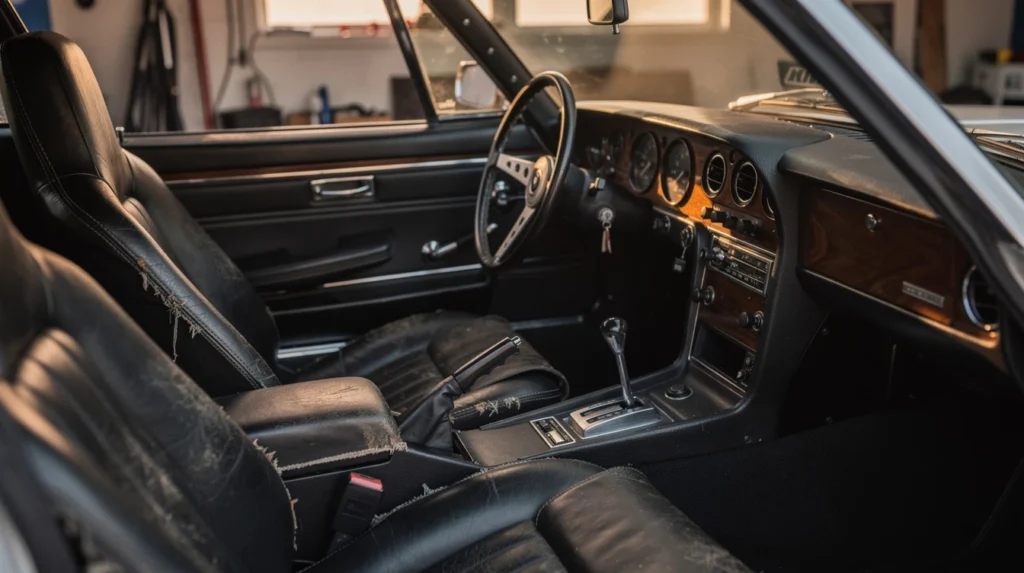

Let me set the scene for you: a Sunday morning, coffee cup in hand, I cast an affectionate glance at my old coupe parked in front of my house. Suddenly, bam! I realize that my headliner is pathetically hanging its last hopes over the seats, the carpet smells like an old cellar, and the leather has taken on the wrinkles of a centenarian newborn. And you know what’s worse? People ready to massacre all that in the name of a modern renovation. No, no, and no again! Restoring the interior of a classic or sports car is a real art… and just slapping plastic everywhere doesn’t turn a Citroën into a Bugatti. Stick with me, we’ll talk rags and screwdrivers, but also common sense, sarcasm, and love for detail.
Preserving the original style: mission impossible or just a matter of taste?
There’s something profoundly exasperating about owners who claim to love their classic cars, yet sadly stick on a blue sound system that flashes like a Christmas tree on LSD. These people clearly confuse classic car interior restoration with Open Bar on AliExpress. That’s NOT what we’re after here. Preserve your dignity. And that of your car.
Restoring the cabin means adhering to two golden rules: preservation of the original style and renovation without modernization. You must love noble imperfections rather than chase sterile shine. Farewell neon covers and budget Formula 1-style finishes. For those who wish to go further, car headliner renovation is a key step in regaining original charm. Time for rigor and authentic character.
The trap of modern personalization
You know the classic move: changing every handle to shiny chrome on the pretext that it’s “prettier.” Congratulations, you’ve just turned your Jaguar MK2 into an IKEA kitchen. The slightest contemporary gadget takes ten points off the charisma of your beloved road companion.
It’s better to keep the period sobriety, even if it sometimes involves a few creaks or a fickle air conditioning. So put your creativity to work elsewhere, like knitting sweaters for dogs. Or your friends, that works too.
Selecting the right materials: the purist’s test
Interior restoration involves material treatment for original leather, vinyl, or plastic – and there, DIY impersonators are quickly unveiled. Choosing the right products is child’s play: just ask someone who really knows, instead of barreling into the local supermarket.
Avoid at all costs multicolored sprays and other miracle stain removers that promise to dissolve everything but the original grime. Even for carpets and rugs, there are better options than a stinky foam in a cheap can.
Interior cleaning: back to basics but without a washing machine
If I had a euro for every time someone asked me, “how do you keep the original seats clean?”, I could probably buy that famous Aston I’ve been dreaming of longer than my beard. We often forget: before repainting, sanding, or dismantling, it’s necessary to clean. But beware, no drowning the interior in buckets of soapy water.
First step: a worthy vacuum cleaner, not the one rescued from the last flea market, ready to gobble up more bolts than it cleans dust. Then, methodical passes on each surface, with soft brushes for fabrics and carpets, because here we are talking about carpet and rug maintenance, not creating a textile battlefield.
Degrease without aggressive treatment of the myth
For anything related to material treatment, the key word is extreme gentleness. Scrubbing like a maniac on leather lands you in the hall of fame for worst restorations. Use specific soaps, avoid chemical solvents, and hydrate the leather as if it were a Hollywood star confined in an anti-botox clinic.
Plastic or vinyl trims also react instantly when they meet the wrong formula. Prefer a neutral product, even if the thrill of trying something that “smells like cherry” is great. Trust me, cherry has never rejuvenated anyone, nor any dashboard.
Carpets and rugs: a minefield for weekend DIYers
Some think vacuuming is sufficient. Wrong choice! Maintaining these poor textile elements, often tortured by decades of muddy shoes and incontinent dogs, requires meticulousness, patience, and, yes, a bit of know-how. A steam cleaner, used respectfully, will improve the overall look without turning the car into an improvised sauna.
For rust stains on the edges of carpets, prefer a targeted intervention: baking soda and white vinegar are more effective (and less toxic) than most overpriced "miracle solutions."
Getting rid of the car’s wrinkles: paintless dent repair and company
Let’s be honest: nothing ruins a nice classic car interior restoration like a sneaky dent on the fender or a rust halo dripping on the door frame. Rather than repainting entirely and ending up with a discordant color, bet on paintless dent repair.
It’s effective, clever, and above all, less risky for the sentimental and market value of your gem. For the bodywork, it’s best to address rust quickly, as it loves to proliferate as soon as you turn your back, a bit like bad habits among campaigning politicians.
The battle against rust: the eternal hunt
Let’s not kid ourselves, restoring the bodywork always involves those pesky corrosion points. They sneak in, especially on lower parts and around joints. Clean, strip, apply an appropriate rust converter, and repaint locally, that’s the plan!
Don’t hope to erase twenty years of acid rain with a magic cloth. Perseverance is the only recipe that works, as treating rust is like training a cat: you think you’ve won, but it always comes back.
Bodywork restoration without erasing the past
We want to avoid the “out-of-factory” syndrome that betrays a total facelift. Yes, a chip of paint or a trace of usage is the equivalent of a laughter line on a face. A touch of patina gives soul. Repainting only the truly damaged surfaces allows you to retain that indefinable retro charm.
By regularly maintaining these critical areas, you mostly prevent having to start all over again in three years. A short-term investment to spare you migraines and ruinous expenses.
Why call on CH renovates headliner in Houilles for your automotive interior renovation?
Now, if you feel your level of patience evaporating faster than a glass of rosé in the sun, it’s time to admit your limit. Because spending your weekends with your nose under the seats is frankly not for everyone. Fortunately, in Houilles, there’s a detail-oriented craftsman: CH renovates headliner. Far from big industrial chains, here, the quality of proper craftsmanship takes precedence, and one immediately feels that classic car interior restoration is almost a religion.
A detached headliner or tired trims? If the thought of repairing stresses you out as much as a condo meeting, let an expert obsessed with details handle it. The address? 40 Rue du Réveil Matin, just a stone's throw from the Houilles - Carrières-sur-Seine train station. One couldn’t dream of a more appropriate street name to refresh a dozing car, right?
Flexible hours and direct contact
At CH renovates headliner, we know what it’s like to have an agenda worthy of a minister. The service welcomes its clientele during the following hours:
- Monday to Friday: 9:00 AM – 5:00 PM
- Saturday and Sunday: 10:30 AM – 5:00 PM
And no more hell of robotic standards. Here, you call directly at +33 7 81 12 18 49, and you chat with someone who knows how to fit a windshield seal without a YouTube manual.
Passionate expertise and commitment to quality
Every renovation performed is a small miracle of precision. This detail-obsessed craftsman masters material treatment of leather, vinyl, and plastic, respects the integrity of the vehicle, and guarantees finishes worthy of a museum (without the dust or safety cord).
The promise is simple: restore the original beauty of your cabin while ensuring long-lasting protection against the ravages of time and use. You seek perfection, not a supermarket parking tuning parade. Moreover, ten out of ten clients rate this service five stars, which seems almost suspicious as it borders on infallibility. But clearly, no one has come back to cry. There must be some justice in the automotive world.
Choosing the right products to enhance without betraying
Here, we tackle the heart of the problem. The shelves of specialized stores are filled with magical bottles and supposedly universal formulas. In truth, 90% of them would be better suited to a bowling alley’s supply room than your garage. Choosing the right products means considering the original texture, color, and even the age of the material.
Most of the time, the best results come from simple and proven recipes: natural soap on leather, moisturizing milk without silicone, or specific wax for delicate plastics. Absolutely ban everything that promises instant miracles with a lingering chemical smell.
Regular maintenance to avoid disaster
Don’t wait for major damage to act. Weekly cleaning, stitching inspection, gentle dusting of vents: nothing beats preventive vigilance for preserving the original style. This saves you from having to invest in a complete repair kit or, worse, in a second-hand seat that has already hosted three generations of inveterate smokers.
Think of it like a spa session for your car. After all, you take care of your leather shoes, so why neglect the upholstery that supports your august backside?
Classic pitfalls to avoid during renovation
Ah, the temptation of “cheap DIY”! Laying down new “compatible” covers or wildly dyeing the dashboard is a surefire way to irreparably ruin the sought-after vintage atmosphere. By trying too hard to correct flaws, you sometimes end up erasing all personality.
Prefer partial and targeted restoration, so that each element retains its patina, its smell, its unique touch, even if it means tolerating two buttons in different colors. Be realistic: no one scrutinizes the woodwork with the rigor of a Louvre expert. Except maybe your mother-in-law, but she’ll complain regardless.
A final word for the road
Restoring the interior of a classic or sports car without altering its style is like juggling with ostrich eggs: it requires skill, patience, and above all, the will to go against the cult of excessive modernization. With a bit of method, respect for the object, and a dash of irony, you’ll not only have saved the soul of your vehicle but also gained the satisfaction of being better than those who install purple neon lights “for fun.” Come on, go wake up that sleeping cabin… and remember: a car that retains its history is always better than a car pretending to be young with shiny plastic prosthetics.
Si vous souhaitez lire d'autres articles tels que How to restore the interior of a classic or sports car without altering its style, consultez la catégorie Non classé.
Leave a Reply
Articles relatifs