China's strategies for manufacturing safe and fire-resistant electric vehicles in the event of extreme impacts

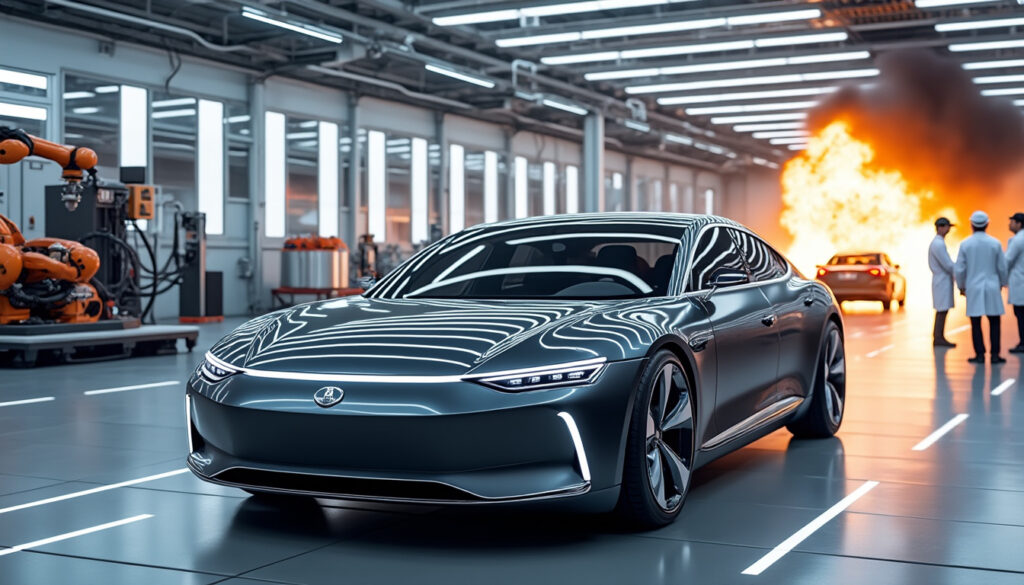

China's strategy regarding electric vehicles is not only a response to a growing demand for more sustainable mobility but also a security imperative due to increasing criticisms about the dangers related to vehicle fires. With high-profile incidents fueling consumer concern, the Chinese government has recently implemented new strict standards aimed at ensuring the safety of electric vehicles through unprecedented standards regarding batteries. These initiatives, which demonstrate China's level of commitment to road safety, speak volumes about its rise in the global automotive industry.
China's Leadership in the Electric Automotive Industry
For several years, China has established itself as one of the global leaders in electric vehicles. Through an aggressive industrial policy, it has managed to take a dominant position in the market. Major brands such as BYD, NIO, Xpeng Motors, and SAIC Motor are emerging as essential players in this revolution. Their strategy relies not only on technological innovation but also on political choices that encourage sustainable development.
Massive investments in charging infrastructure, combined with government subsidies, encourage consumers to adopt these vehicles. At the same time, China has also invested in advanced battery technologies capable of withstanding extreme conditions. This is particularly important as the issue of battery lifespan and safety is at the heart of consumer concerns.
Iconic Brands and Their Impact
Companies such as Li Auto and Geely are also participating in this dynamic. Here are some initiatives implemented by these companies:
- Research and Development: A focus on innovation and research.
- Safety Standards: Voluntary adoption of safety standards before regulation.
- Consumer Education: Initiatives aimed at raising awareness among users about battery safety.
For example, Great Wall Motors has invested in fire detection systems integrated into its vehicles. This shows how safety has become an imperative for these companies.
Challenges Ahead
Despite this privileged position, China faces several challenges, including the need to maintain high safety standards to avoid scandals. Recent incidents of fires, such as one involving a Xiaomi vehicle, highlight the fragility of public perception. Regulations like the GB38031-2025 standard are therefore direct responses to these concerns.
The GB38031-2025 Standard: Towards Enhanced Safety
The GB38031-2025 standard represents a crucial turning point in the electric vehicle sector in China. Scheduled to come into effect in July 2026, this regulation imposes strict safety requirements for batteries.
The features of this standard include:
- Battery resilience against internal short circuits.
- Ability to survive shocks under the vehicle floor.
- Emission of non-toxic fumes in the event of a potential fire.
Whereas previously, the user was only warned five minutes before a potential incident, the new regulation aims to ensure that no fire starts, even in the case of a major failure.
| Requirements of the GB38031-2025 Standard | Main Features |
|---|---|
| Short-circuit resistance | Must be able to withstand extreme conditions without catching fire. |
| Fume emissions | Generated fumes must be harmless to passengers. |
| Failure detection | Early alerts for combustion risks. |
These new regulations express not only a need for technological innovation but also a desire to improve the public perception of electric vehicles systematically. This goes beyond simply selling cars and touches on the social acceptance of electric vehicles.
Additional Safety Measures and Government Response
To support the implementation of this standard, the Chinese government has put in place several measures. Notably, it decided to prohibit mentioning autonomous driving in advertisements after an incident related to a vehicle. This indicates a desire to reduce unrealistic expectations from the public regarding what is technically possible at this time.
Among the initiatives launched are:
- Collaboration between companies and authorities for quick compliance.
- Training for content creators and advertisers to ensure responsible communication.
- Regular revisions of safety standards to keep pace with innovations.
This proactive approach could be a model for other countries. Furthermore, China shows a clear willingness to strengthen its image as a leader and innovator in electric vehicles.
A Comprehensive Strategy to Build Consumer Trust
It is essential to strengthen consumer trust in the face of these new realities. While pursuing its growth, China will need to navigate between technological innovation and public perception. Brands like Tesla China and Honda China are also in this race, making the landscape even more competitive and requiring constant attention to safety.
The Future of Electric Vehicles and Ongoing Innovation
As China looks towards the future, innovation is a central pillar of its strategy. Research and development of batteries as well as intelligent safety systems will continue to evolve. Companies such as Changan Automobile and Great Wall Motors are investing in technologies that enable early detection of failures.
It is crucial to note that the future of electric vehicles does not only lie in their ability to charge quickly, but also in their resilience to accidents or technical failures. The safety of occupants is therefore paramount, and China has understood this. To maintain this lead, it is committed not only to comply with regulations but also to exceed them.
Conclusion: Towards a Global Automotive Industry?
The Chinese strategy regarding electric vehicles constitutes a model to follow. By concentrating its efforts on safety, sustainability, and innovation, China shows that it is ready to become the model for the future of the global automotive industry. Key players such as Xpeng Motors and Li Auto, along with proactive regulation, can significantly reshape the automotive landscape. This only underscores the strength of the Chinese approach to modern challenges in the automotive sector.
Si vous souhaitez lire d'autres articles tels que China's strategies for manufacturing safe and fire-resistant electric vehicles in the event of extreme impacts, consultez la catégorie Non classé.
-
Liora Shun says:
La sécurité des véhicules électriques est essentielle. Ces nouvelles normes sont une bonne initiative pour rassurer les consommateurs.
Leave a Reply
Articles relatifs