Rivian and Volkswagen: an underrated collaboration poised to revolutionize the automotive industry

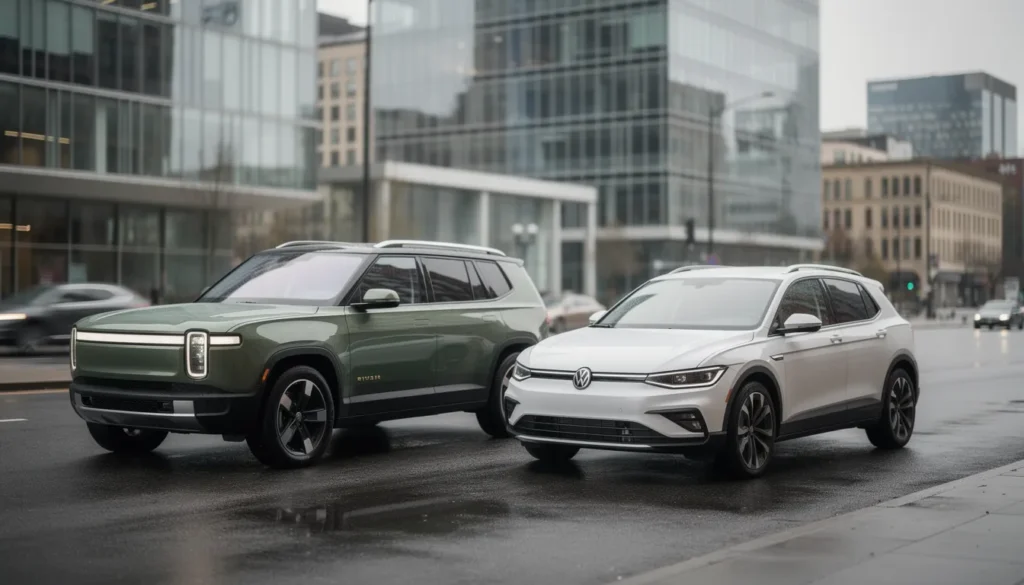

The current automotive scene resembles a big circus where performers desperately try to juggle electric cars, complex software, and promises of revolution. But here’s the thing, between Tesla and BYD, the competition is fierce, especially for those who feel like they have arrived a bit too late to the party. So what happens when Rivian, this overly enthusiastic challenger, crosses paths with Volkswagen, this giant with its nose buried in past mistakes? You get an alliance that could well redefine the rules of the game, or not.
Just a year ago, the two companies announced a shiny new joint venture - RV Tech - based on a staggering investment of 5.8 billion dollars. Someone needs to tell Volkswagen that those amounts could nearly make an oligarch blush! In this happy construction site, over 1500 employees are bustling between the United States, Canada, Sweden, Serbia, and Germany, like an army of industrial ants ready to conquer the world of electric automotive industry. The goal? To develop a new electrical architecture to equip the cars of tomorrow. What a noble ambition! But an ambition so grand that it could have blown up a nuclear fusion reactor.
A strategic partnership with dizzying ambitions
This partnership is not just a technical collaboration, it’s a genuine attempt at catching up. Volkswagen, with its software division Cariad, has dragged its feet so much that one wonders if they are using knobby tires like in the 90s. The result? Delays, restructurings, and the play of the century on the stage of failure. So, to compete with the champions of sustainable mobility, they need to roll up their sleeves and innovate, and not just settle for rolling some sheet metal.
A zonal architecture that promises miracles
The flagship element of this collaboration is the idea of a zonal architecture, a revolutionary concept to simplify all this electrical mess in vehicles. Imagine: fewer cables tangled like spaghetti, fewer controllers scattered around your car, a real simplified electronic mess. Honestly, who hasn’t wished that their car could be repaired as easily as an old-fashioned clock radio? With this innovation, the manageability of over-the-air updates should be so simplified that even your grandmother could deploy them over the Internet. The capacity for autonomous driving functions might, who knows, not just remain in the dreams of dreamy engineers!

Tests scheduled for 2026: soon on the road?
The timeline seems ambitious, almost unreal. Winter testing of the first co-developed cars will start in the first quarter of 2026. It’s almost as if these engineers think they need to give themselves some time to fall into a snowstorm, just to make things even more tricky. The Audi and its partner Scout will share a similar architecture, while the ID.Every1, this entry-level model, is expected to debut in 2027. Why? Because it’s time to get this beautiful bunch on the road and see whether or not they are ready to compete with the monster that is Tesla.
Rivian's long-term vision is not just to make cars. No, they are also keeping an eye on other manufacturers, with the brilliant idea of selling their technology in the way that Google does with its famous Android. Maybe soon, your car will be on the market to get updates as frequently as a dating app. One can dream!
A response to geopolitical challenges
This partnership also appears to be a clever response to new geopolitical tensions. While Volkswagen seeks to establish links with Xpeng in China to circumvent software restrictions, its new alliance with Rivian is a true chess game, where every move counts. Catching up to Tesla while bypassing Chinese obstacles, that is a challenge of impressive scale, almost worthy of a great spy novel!
And for those wondering how Volkswagen could transition from an obscure past to a bright future in automotive technology, look at this collaboration. It could very well be the shining example of a strategic evolution where innovation meets tradition, as long as they don’t tinker too much with the engine.

Source: rouleur-electrique.fr
Si vous souhaitez lire d'autres articles tels que Rivian and Volkswagen: an underrated collaboration poised to revolutionize the automotive industry, consultez la catégorie Volkswagen.
Leave a Reply
Articles relatifs