Renault opts for a bold strategy in response to the decline in electric car sales



The automotive sector is undergoing major upheavals, and Renault is no exception. As electric vehicle sales plummet, the French manufacturer is trying to restore its image with an innovative strategy. This evolution is crucial for its survival in a rapidly changing market, where giants like Tesla, Volkswagen, and Ford are reshaping the landscape. With a renewed positioning, Renault is committing to a future where electric options will coexist with thermal models. This decision could very well be the defining turning point for the brand.
Market transformations and their impacts on Renault
Facing a global automotive market that is constantly evolving, Renault must adapt to remain competitive. The rise of electric vehicles, coupled with logistical and economic challenges, has led the manufacturer to rethink its strategy. Consumers, increasingly sensitive to ecological issues, favor electric models. However, customer frustration over limited range and the prohibitive cost of certain vehicles has also led to a mixed response to electrification.
The rise of competitors in the electric sector
Market players, particularly Tesla, Volkswagen, and Ford, have made significant moves with innovative and appealing offerings. Tesla, with its flagship models, has captivated an audience already enamored with the idea of an energy transition. Volkswagen, on its part, has implemented a bold strategy with attractive electric ranges, adapting its production network to include more electric vehicles. Ford, with its F-150 Lightning, has also made waves in the electric truck market, demonstrating that it is possible to blend performance and ecology.
In response, Renault has had to observe these developments while adjusting its own offerings. The necessity to create models that are not only competitive in terms of electrification but also accessible has become imperative. It is in this context that Renault launched its strategic plan, dubbed Renaulution, which aims to reorganize the brand by addressing consumer concerns.
Renault's strategic shift
Renault has decided to adopt a mixed strategy that ties electric cars and thermal models together. The manufacturer has understood that an exclusive electric approach could prove risky, especially at a time when the supply chain for batteries is becoming a major issue. With rising raw material prices and increasing demand, this diversification could prove beneficial.
Within its new strategy, Renault plans to introduce new electric models at affordable prices while maintaining its thermal models. This approach not only allows capturing a wider audience, but also addresses questions regarding the range of electric vehicles.
The new range, focusing on accessible electric vehicles, aims at a dual objective: to conquer new customers while stimulating interest in the brand. At the same time, Renault is not hesitating to invest in cutting-edge technologies to ensure better energy efficiency of its future models.
Analysis of sales figures and forecasts
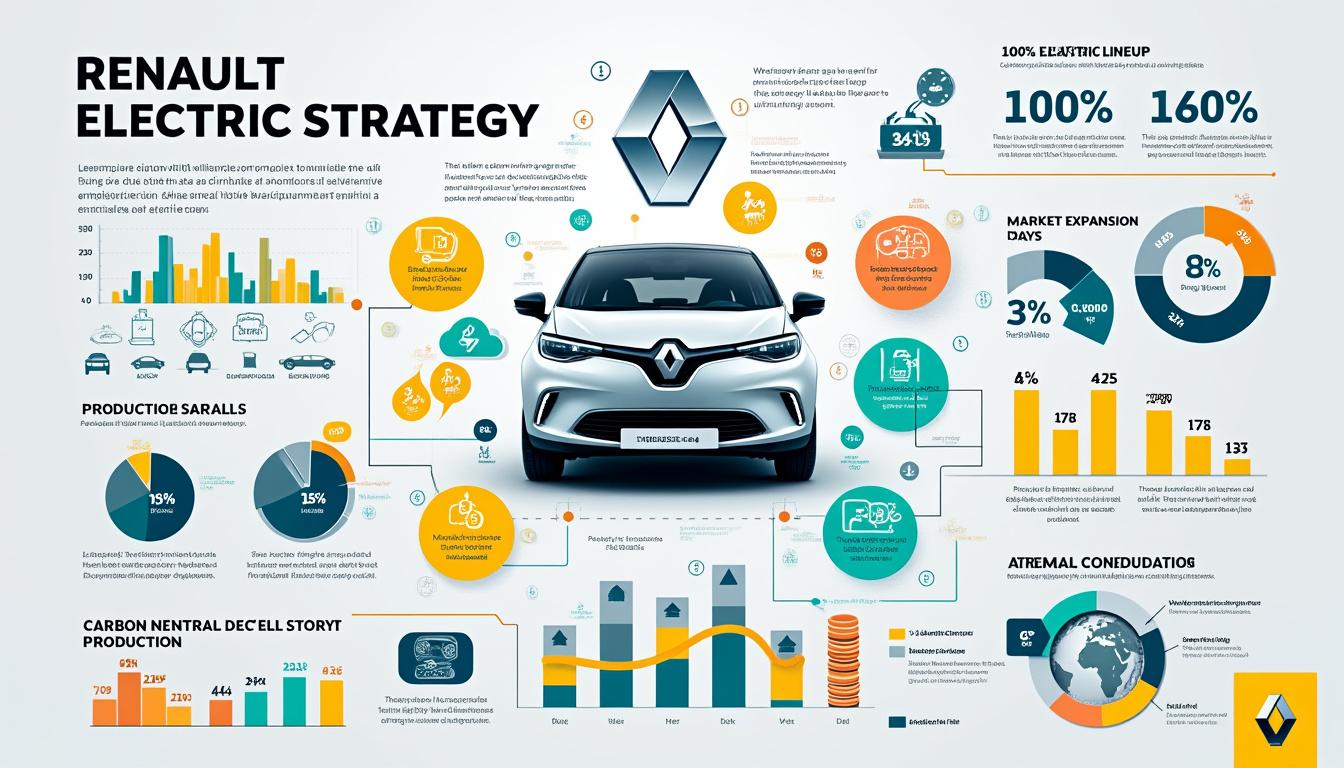
The latest sales trends from Renault reveal a worrying decline in registrations of electric vehicles. In 2023, the share of electric cars within the Renault group fell to 7.6%. This figure is significant, notably considering that the Renault brand alone had a figure of 11.6%. This decline raises questions about Renault's competitiveness compared to other brands like Peugeot, Citroën, and Nissan, which seem to navigate these tumultuous changes better.
Factors influencing the decline in sales
The drop in electric vehicle sales can be explained by several factors:
- Cost of vehicles: Despite a gradual decrease in prices, electric cars often remain more expensive than their thermal counterparts.
- Limited range: Many consumers are still concerned about the range of electric cars.
- Charging infrastructure: The lack of charging stations also hinders potential buyers.
- Government incentives: Changes in government aid programs significantly impact the market.
- Increased competition: The excellence of competitors' offerings gradually attracts hesitant customers.
| Year | Electric vehicle sales (in units) | Market share (%) |
|---|---|---|
| 2021 | 60,000 | 12% |
| 2022 | 50,000 | 9% |
| 2023 | 30,000 | 7.6% |
This situation, although concerning, is not definitive. Renault has the opportunity to reverse this trend with its Renaulution strategy, which maintains a particular focus on innovation, model diversification, and responding to market needs.

Anticipating new trends: towards an electrified dealership
By 2025, Renault plans to launch a completely new concept of electrified dealership. This initiative aims to highlight the customer experience while offering a valuable display of the electric range. This new dealership model could not only attract customers but also serve as an example for other brands.
The concept of an electrified dealership
This concept is based on dedicated spaces that highlight the benefits of electric vehicles. The traditional dealership transforms into a collaborative space where consumers can enjoy in-depth explanations about:
- Embedded technologies:
- Performance of electric vehicles:
- Charging solutions:
- Maintenance and follow-up programs:
This model promises to improve the interaction between the customer and the seller, thus transforming Renault's image into a key player in electrification. Groups like BMW and Audi could also be inspired by this initiative to reinforce their own image.
Importance of the transition towards a sustainable approach
By developing green and sustainable solutions, Renault aims to reduce its carbon footprint while meeting the growing expectations of customers. This shift towards green could not only strengthen the brand's position in the market but also inspire a broader movement within the automotive industry.
| Planned Innovations | Potential Impact |
|---|---|
| Accelerated charging offer | Improvement of accessibility of electric cars |
| Hydrogen vehicles | Alternative offer to electric vehicles |
| Collaboration with start-ups | Acceleration of technological innovation | Integration of autonomous driving | Enhanced customer experience |
The challenge of competitiveness in a saturated market
For Renault, competitiveness is not just about technology or brand image. Supply chain management, as well as the ability to quickly adapt to market fluctuations, are crucial issues. In an automotive ecosystem where companies like Hyundai and Volkswagen are constantly evolving, Renault must maintain its innovation capability without compromising product quality.
The supply chain: a strategic issue
The automotive sector is increasingly dependent on raw materials for battery manufacturing. Companies such as Nissan and Toyota strive to secure their supplies in the face of rising demand. Renault, aware of these developments, is also interested in diversifying its suppliers to reduce supply risks and ensure its long-term electrification ambitions. Initiatives to pool resources with other players, such as a potential collaboration with BYD for example, could also be considered.
Innovation challenges amid tight deadlines
The growing pressure to develop new models within a tight timeframe raises a critical question. With giants like Ford and Volkswagen investing heavily in research and development, Renault must redouble its efforts to stay relevant. Introducing models in less than 21 months is a bold yet realistic challenge considering current technological advancements.
Beyond merely producing electric vehicles, the challenge for Renault is to create an integrated ecosystem around its products. This includes efficient after-sales services and quality customer support, which would help strengthen brand loyalty.

The impact of legislative developments and government incentives
The legislative framework plays a determining role in Renault's strategy. Political intentions to evolve the automotive market are crucial. The trend towards stricter regulations regarding carbon emissions and the promotion of electric vehicles reinforces the necessity of having a diverse and complete range. Renault must stay alert to these developments to adjust its approach.
Adapting to environmental regulations
Developments such as the ban on the sale of thermal vehicles by 2035 in several European countries force Renault to prepare for this transition. Carbon emission regulations also weigh on the marketing of new models. These constraints, while challenging to manage, can also be a source of creativity and innovation. By anticipating the expectations of regulations, Renault could tap into a customer base seeking solutions that convey ecological awareness.
For future models, Renault has already announced technologies aimed at reducing emissions while improving performance. This could reassure environmentally conscious customers and provide a more positive image.
Government incentives: a strategic lever
To support the transition to electric vehicles, governments are planning many incentives. These grants for electric car purchases play a key role in consumer choices. Conversion bonuses and subsidies are key elements that influence purchase decisions. Renault has the opportunity to contribute to these efforts while strategically positioning itself in the market. For example, offering varied models at competitive prices could capture customer interest while facilitating access to an electric vehicle.
Even if these incentives were to disappear, Renault could focus its efforts on more affordable ranges to remain competitive.
As Renault prepares to meet these challenges, its vision for 2025 seems more than ever focused on a bold reinvention of its strategy. By offering a diversity of models while keeping an eye on innovation and sustainability, Renault hopes to forge a bright future within a changing automotive sector.
Si vous souhaitez lire d'autres articles tels que Renault opts for a bold strategy in response to the decline in electric car sales, consultez la catégorie Non classé.
-
Elowen Faure says:
Renault doit vraiment innover pour ne pas perdre encore plus de parts de marché.
Leave a Reply
Articles relatifs