Toyota and Volkswagen are considering repatriating some of their production to the United States

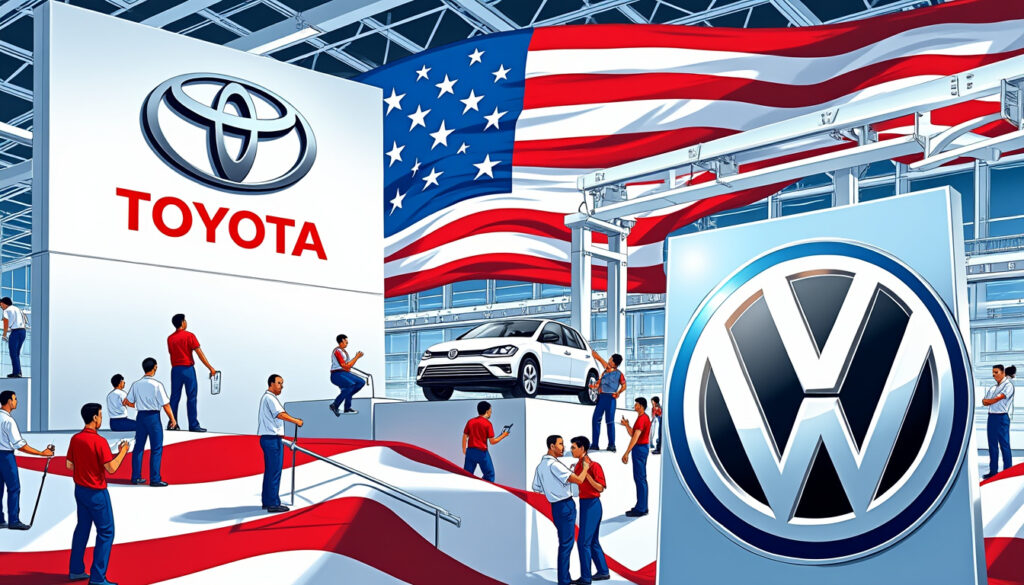

Ah, the automotive industry, this never-ending theater where the main actors shift in their seats in a geopolitical vaudeville with tariff barriers. This time, Toyota and Volkswagen, two giants of the wheel, seem finally to be throwing in the towel against Uncle Sam's tariff torpedoes. The Trump administration indeed prepared its blow by imposing hefty tariffs of 25% on imported cars, and now our protagonists are seriously considering bringing part of their production back to American soil. Incredible, isn’t it? After years of offshoring to scrape a few cents, the White House is now reaping the bitter fruits of this protectionist policy. But rest assured, it doesn’t stop there: Ford, General Motors, Honda, Nissan, Chrysler, Hyundai, Tesla, Subaru… the American hive is buzzing, each manufacturer adjusting its pieces to avoid becoming fodder for the taxes. The race is on, and it won’t be tomorrow that American asphalt finds itself devoid of foreign engines.
Toyota and Volkswagen: a triumphant return of automotive production to the United States
While one might have thought that Toyota, this Japanese giant that has been sitting at the top of the global ranking since 2020, would continue to ignore the American market—so as not to upset the sacred balance of costs—here it is making a U-turn. According to well-informed sources, Toyota is considering producing the next generation of the RAV4 at a factory located in Kentucky. A small revolution, since until now, this SUV, king of American roads, rolled off the lines in Canada and Japan. And for good reason: with over 475,000 units sold in 2024, the RAV4 is not just a bestseller, it’s a rolling monument that it would be foolish to leave at the mercy of tariffs. Volkswagen, for its part, is also keeping pace: its president Oliver Blume has stated with disconcerting seriousness that a local production of Audi would be part of a “development strategy.” Translation: no more beating around the bush, the four-ringed vehicles could very well take root on American soil. Not really a surprise when you know that over 240,000 Audi vehicles have found buyers in North America in 2024. A drop in the ocean of industrial strategy? Not at all, rather an imminent tidal wave to counter tariffs and stabilize currency fluctuations like that damned yen.
The impact of tariffs and the repatriation strategy of manufacturers
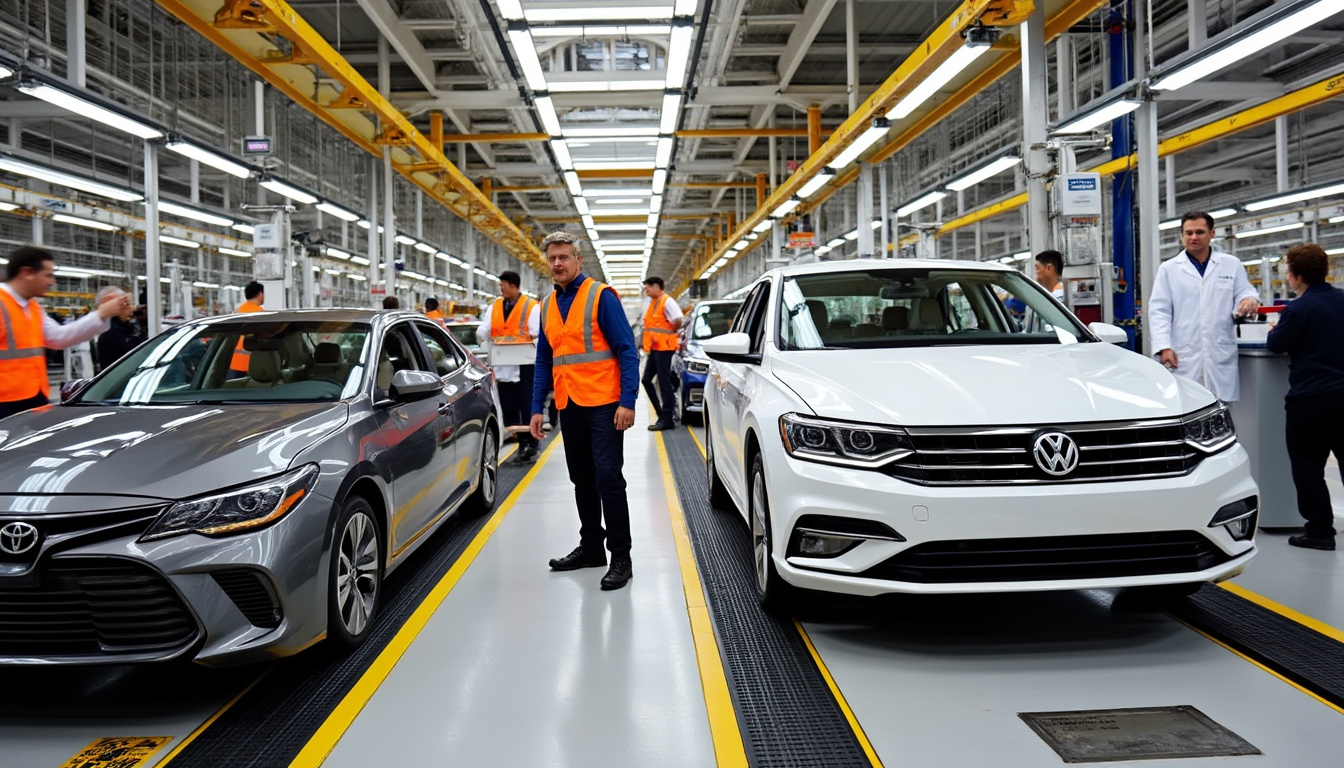
Tariffs of 25% are a bit like an old English pub suddenly raising the price of a pint by half: it really cools the ardor. For Volkswagen, Toyota, but also Honda, Hyundai, and Volvo, this tax is a real sledgehammer—a sufficient reason to consider a return to the roots of their production, namely America. The goal? To prevent the American customer from having to cough up extra for a car whose only crime is having crossed the ocean. This repatriation, announced with great fanfare, will certainly disrupt the industrial landscape and, above all, show that sometimes globalization has its limits.
This also reminds one of the leopard that suddenly finds itself stuck in its enclosure after wandering in the tall grass: manufacturers, long gone looking for savings elsewhere, find themselves forced to settle back in the precarious American industrial fabric. Even Ford and General Motors must be crafty, as the rules of the game become stricter as the protectionist wind shifts. To learn more about the consequences of these measures, some media have already begun dissecting the phenomenon, notably on GT Automotive.

The American market, a playground that Audi and Toyota won’t refuse
The American market is a bit like the local godfather. Hundreds of thousands of cars are sold there each year, and for those who place a bet on it, it’s a potential jackpot. Audi, which has carved out a prime share with its German elegance, is performing brilliantly there, imposing nearly a quarter of a million annual sales. Relocating its production on-site is thus a strategic no-brainer, a poker move against the taxes that are squeezing its margins.
For Toyota, the situation is similar. The RAV4 is a true star, and the mere act of producing it locally will curb fluctuations of the yen and whimsical industrial territories. The planned factory in Kentucky is thus a strong signal, in a region where the automotive industry still gives cold sweats to Elon Musk and his troops. As for other players like Nissan, Chrysler, and Subaru, they are watching and likely preparing their moves in the shadows.

A significant trend to follow closely
This return to a certain form of automotive "Americanism" will not stop there. Honda, Hyundai, and Volvo have already strengthened their industrial presence across the Atlantic, foreshadowing a new economic model in response to the whims of trade policies and monetary markets. It seems that globalization, that old siren too often sung, is slowly being spurned in favor of pragmatic retreat. In this context, monitoring these industrial trajectories has become as exciting as watching a football derby between two teams that don't want to lose.
For those who want to understand the implications for car insurance or navigate the intricacies of used cars in France, a visit to GT Automotive and LOLivier is essential. Because in this game of musical chairs, even behind the wheel, one must be well-prepared for the carnage.
Source: www.ledauphine.com
Si vous souhaitez lire d'autres articles tels que Toyota and Volkswagen are considering repatriating some of their production to the United States, consultez la catégorie Non classé.
-
Lysandre Verneuil says:
C'est fascinant de voir comment les tarifs influencent vraiment la production automobile.
Leave a Reply
Articles relatifs